Best Practices in Welcoming DeafBlind Patrons and Partners
VOX has partnered with Silent Rhythms to create free, open source modules to teach arts organizations best practices in welcoming the DeafBlind community. These modules explore topics like DeafBlind etiquette, communication, accessibility in museum and theater spaces, audio description, braille, technology and more. All of these modules are presented and produced by DeafBlind professionals and supported by Deaf/Hard of Hearing, CODA, and ASL interpreter community members. These modules are presented in American Sign Language with English voiceover, or spoken English with picture-in-picture ASL interpretation. All videos have captions and a transcript below the video to follow along.
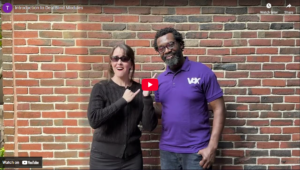
Introduction to DeafBlind Modules
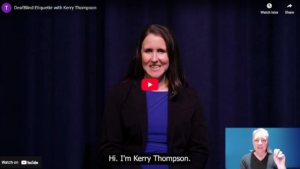
DeafBlind Etiquette with Kerry Thompson
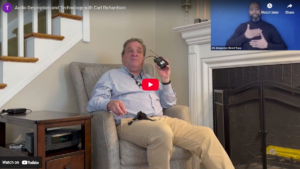
Audio Description and Technology with Carl Richardson
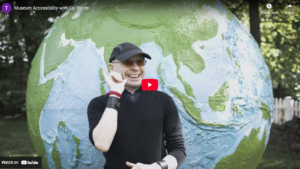
Museum Accessibility with Cai Steele
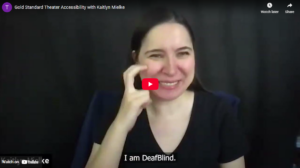
Gold Standard Theater Accessibility with Kaitlyn Mielke
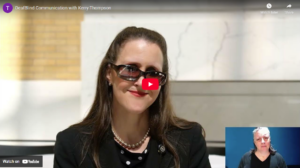
DeafBlind Communication with Kerry Thompson
Introduction to DeafBlind Modules
Details: A brief introduction to the DeafBlind Modules assembled by Silent Rhythms and Think Outside the Vox featuring respective co-founders Kerry Thompson and Christopher Robinson.
Credits:
Videographer: Ingrid O’Dell
Editor: Connor Riordan
Voiceover: Kerry Thompson, Christopher Robinson, Connor Riordan
Set ASL/ProTactile interpreter: Ingrid O’Dell, C Ledford
Description: two presenters will self-describe in this two-minute, 44-second module. Both sign using American Sign Language and deliver as their own voiceover. When one is not signing/speaking, a hand remains on the other’s back to backchannel as a tactile marker of “I am here and absorbing what you are communicating.”
VOICEOVER: Presented by: Think Outside the Vox and Silent Rhythms. [Both the VOX logo and Silent Rhythms logo, which is two pairs of cross stepping feet on a drum.]
KERRY: Hi, my name is Kerry Thompson. I’m a white woman standing next to a brick wall. I’m the Executive Director for Silent Rhythms. I am also a person who identifies as being DeafBlind. I would like to introduce you to my friend – I will actually let him introduce himself.
CHRIS: Hello, I am Chris Robinson. I am a hearing Black man with curly locs at the top, and I am bearded, wearing a purple VOX shirt. I am one of the co-founders and Vice President of VOX. We are delighted to partner with Silent Rhythms and Kerry to educate all of you and theater venues about the best way to be more inclusive of the DeafBlind community. So congratulations on being here.
KERRY: As a person who is DeafBlind, I want to experience the arts. I want to go to the theater and have a multi-dimensional experience of the show myself. I want to help you all learn about the different ways that DeafBlind people communicate, the different technology that DeafBlind people use, and the ways that you can support us.
For example, how to guide someone to their seats; how to describe the surrounding environment; how to guide someone up and down the stairs and within an elevator. All of that will make for a positive and inclusive experience for patrons who are DeafBlind, who want to experience the story onstage and offstage. Thank you. We hope you enjoy the modules.
[CHRIS and KERRY show Deaf applause with waving hands}
Thank you again!
CHRIS: Bye!
DeafBlind Etiquette with Kerry Thompson
Details: What should venue staff know about the DeafBlind community? What should people know about canes and service animals? Plus, an introduction to ProTactile, tactile communication, and how to approach someone who is DeafBlind.
Credits:
Videographer: Connor Riordan
Editor: Connor Riordan
Venue: Open Door Theater
ASL interpreter (picture-in-picture): Rachel Judelson
Set ASL/ProTactile interpreter: Ingrid O’Dell
Production Assistant: Sam Gould
Special Thanks: Dragonfly Theater, Acton-Boxborough Regional School District
PRESENTER: Presented by Think Outside the VOX and Silent Rhythms. [Both the VOX logo and Silent Rhythms logo, which is two pairs of cross stepping feet on a drum.]
[Kerry sits and speaks in front of a blue curtain. Rachel, the ASL interpreter signs in the bottom right corner of the screen].
KERRY: Hi. I’m Kerry Thompson. I am very excited to introduce this module on inclusion and accessibility for people who are DeafBlind at the theater and at museums. This module will focus on what venue staff can do to make the experience more accessible and enjoyable for people who are DeafBlind.
QUESTION: What should venue staff know about the DeafBlind community?
KERRY: So for people who are DeafBlind, you need to think about the spectrum of their Deafness. So their Deafness could be that they are hard of hearing. They could be fully Deaf. They could be somebody who is using a cochlear implant or a hearing aid. For the Blind spectrum, you have to understand that there are people who are fully Blind or low vision, and within those two spectrums, that it’s possible that their spectrums will change over the course of their lifetime. It is important to ask: what does one need?
QUESTION: What should people know about white canes?
KERRY: A white cane is universally recognized as a tool being used by someone who is visually impaired. They may be Blind or Low Vision. So one should not assume that someone
holding a white cane is fully Blind. Some people are low vision who have some good central vision but lack peripheral vision and need to use a white cane to help. One should never touch a person’s white cane or try to move it to help guide them.
QUESTION: What should venue staff know about service animals?
KERRY: You should never pet the animal. You should never try to feed the animal. You should not interact or try to make eye contact with the animal. If you want, you can offer some assistance to the handler, such as pointing to where they can get some water for their animal. It’s important that you’re also mindful that service animals will need to have a place to relieve themselves. So be aware of what area a service animal can go. And it’s important that it is clear what is the best place for the service animal within the theater. You would ask the handler of the service animal, do they prefer to be seated in – near the aisle or away from the aisle? It’s important that the handler understand the flow of traffic.
QUESTION: What is tactile communication and how does it work?
KERRY: To help me demonstrate some tactile ways of communicating, I’m going to ask my sign language interpreter to approach me.
[the interpreter, Ingrid, a tall white woman with blonde hair tied back, blue eyes and freckles wears a black shirt]
KERRY: The first thing my interpreter did was put her hand on my shoulder. That tells me that she is there. She is next going to skim her hand down my arm so that we can connect with our hands. The first method of communicating through tactile communication is something called tracking. If they’re using sign language and can’t see if it’s down here [Kerry moves signing hands to chest height] the tracking helps move the hand in the position of the window [Kerry signs in front of her chin]. So a person with low vision would see both the hands and the face at the same time. My interpreter is going to sign “How are you?”
So I just put the window over her face [Kerry outlines a rectangle of her vision view, a box around the interpreter’s face], and kept the hand right here by on her wrist. And that is me putting the signing all into one window. For some people who are no longer or never were able to see visually sign language, We use tactile sign language, and tactile sign language is putting the hand on top of the person’s hand. So my interpreter is going to demonstrate signing “How are you?” And my hand, as you noticed, is still on top of her hand, and not on her wrist like tracking was. That’s the difference. I’m actually feeling what she’s signing. I am not using my eyesight. So – how are you?
For tactile communication, one can also fingerspell. So she’s going to fingerspell into my hand. H. I. Hi!
Then there’s another form. It’s not sign language, but it is a form of trying to give information about the environment or what people are doing or saying or feeling. And that is a form called protactile. So my interpreter is going to put her hand on my shoulder. And you can do this on the side of the arm or on the back of a person. Sometimes when seated side by side, you can also do protactile on one person’s lap. And the different thing that you can do for protactile, one would be, if people are smiling, you do a little smiley face [the interpreter draws a smile on Kerry’s shoulder] If people are sad, or angry, you would do sort of a frowny face. [interpreter draws the frown] If people are laughing, you do this sort of tickling motion [interpreter does wiggling fingers lightly tapping on Kerry’s shoulder]. So people are laughing. Ha ha ha. If a person has a question, you would raise your finger up, and you can raise it up on the right side
or the left side if using the back of a person’s back to indicate which side of the room the person is asking that question. If one is leaving and saying goodbye, there are two different farewell protactiles. One is “I’m leaving and I’ll be right back.” To do that is a little sort of a seven. I am leaving, but I’ll be right back. If you are leaving and not going to be back for a while, or we won’t see each other for a long time, you sign “Leaving.” And this is actually the American Sign for leaving. It sort of looks like you’re grabbing and picking up your stuff. [open 5-handshape with all fingers softly pinching together]. With protactile, you just do one hand. So I know that my interpreter is leaving. [the interpreter leaves].
The other thing to know about protactile and tactile communication is that a DeafBlind individual
may make modifications for their own specific requirements and access support.
QUESTION: How do you approach a person who is DeafBlind?
KERRY: if you don’t know sign language, or don’t know if the DeafBlind person knows sign language, the first thing you would do is, as you walk towards them, put your hand on their shoulder. [interpreter enters and puts a hand on Kerry’s shoulder]. That tells me that there is someone there. You may try using your voice to identify yourself.
INGRID: Hi, Kerry, this is Ingrid.
KERRY: The thing if you want to give, like, a greeting, and you want to shake my hand, offer your hand. [Kerry offers her hand at waist level, Ingrid takes the handshake]. Ah! Hello. Nice to meet you. And putting your hand back on my shoulder tells me that you are still there, that you haven’t walked away. If you want to hand me an object, such as a Playbill, you would touch it to my hand, [Ingrid places a large piece of paper in Kerry’s hand] and then I would know that there’s an object coming towards me. To offer guidance to perhaps to enter a room, or to go towards a seat, you would offer your elbow. [Ingrid slides her hand from Kerry’s shoulder to her elbow, then Ingrid slides shifts so that her own elbow is touching Kerry’s.] But remember, don’t offer your elbow out in space and hope that somebody is going to grab it. Pressing your elbow to my arm tells me that the elbow is there so I can easily reach for it. If someone is with a sight guide or a sign language interpreter, you can also wait for them to realize that you are there trying to approach. So you wave to the sign language interpreter to say,
“I would like to come.” The sign language interpreter can then sign to the DeafBlind individual to say, “Someone wants to talk to you.” So if someone wants to talk to me, “Oh! Where are they?” [interpreter then points and shifts her body in the direction of the hypothetical person who wants to chat with Kerry] “Yes?” Or, “Hi!” And you may approach. The sighted guide could also say verbally to the DeafBlind person.
INGRID: Hi, Kerry. Someone wants to talk to you. They’re to your left.
KERRY: If there is a sign language interpreter or sight guide or another individual, a family member, a friend, or a spouse, speak directly to the individual. I know sometimes you may think,
“well, they cannot see me.” But the interaction, the that’s the part about inclusion. You want to make that person feel included.
PRESENTER: A Special Thank You to the following organizations: The Sudbury Foundation. Open Door Theater. The Discovery Museum. And the Mass Cultural Council. [each of their logos in quadrants on the screen].
Audio Description and Technology with Carl Richardson
Details: Accessing theater information as a DeafBlind patron, Carl shows us his screen reader technology, split-Audio Description and enhanced audio or assistive listening technology, and how competent audio description and accessibility affects the overall theater experience for everyone. What should institutions, theaters, and access providers bear in mind about access?
Credits:
Videographer: Olivia Reinebach
Editor: Connor Riordan
ASL interpreter (picture-in-picture): Brent Tracy
Production Assistant: Sam Gould
PRESENTER: Presented by Think Outside the Vox and Silent Rhythms. [Both the VOX logo and Silent Rhythms logo, which is two pairs of cross stepping feet on a drum.]
[Carl a white DeafBlind man sits in his living room in a gray chair with a wooden table to his right, fireplace on his left, and a staircase behind him. He speaks English and interpreter Brent Tracy signs in ASL in the top right corner of the screen.]
CARL: My name is Carl Richardson, and I am an avid theater goer who also has Usher syndrome, which affects both the hearing and vision, so I have a dual sensory loss. Depending on the type of Ushers you have, both can progressively get worse over time. I first fell in love with theater at the age of in my music class, when we were assigned to sing in the music for [Joseph] and the Amazing Technicolor Dreamcoat. Except I wasn’t really a good singer, [laughs] so my music teacher didn’t know what to do with me. So they put me on the production crew. And that’s when I saw the magic of theater.
QUESTION: How do you access information when going to the theater?
CARL: Well, the first thing I do is I go online to check if the information is there, as many theaters and organizations will put information about the play, the background, online. I also use my phone quite a bit to gather information for the world around me. And as a DeafBlind person, this phone does Bluetooth to my hearing aids. So I used a screen reader on the phone called VoiceOver.
[Carl swipes on his iPhone] VOICEOVER speaks: “History. [Unintelligible]. Selected.
Service Directory.”
CARL: By manipulating the phone, I can get all the information that’s on the screen. Now with AI and OCR software, there’s quite a bit of ways to access print information, where historically in the past it was difficult to do. I’m going to use something called Be My Eyes right now, which is AI software. And I’m going to take a picture of this Playbill.
[Electronic chime] BE MY EYES speaks: “Analyzing picture. Please wait. [Electronic chime] A blue flyer for a book festival being held in someone’s hand. The flyer reads ‘Welcome to the ninth Provincetown Book Festival September, Provincetown Public Library, ProvincetownBookFestival.org, all events are free.’ The lower part of the flier has a colorful, abstract illustration.
CARL: I also have OCR software that will read it word for word called Envision, and there’s another one called Voice Screen Scanner. If I take a picture it’ll just read the text only. And there’s – there’s a number of them now, there’s – there’s four or five of them for the Blind community now, that will read text and OCR software, and I can read whole entire documents using my phone. And you – this being AI, I may use it when I go into a theater If I go into, say, the Paramount Theater, and I want to know what the decor looks like, or what the ambiance is,
I use this one that I’ve just used, Be My AI, which is part of Be My Eyes, to describe what’s around me. And it may say like, oh, there’s a stage in front of you with red velvet drapes around you, with people sitting in the theater looking like they’re having a good time, that sort of thing.
QUESTION: What should institutions, theaters, and access providers bear in mind about access?
CARL: You’ve got to maintain your equipment. Make sure it works. Make sure the batteries are fully charged. Make sure the headphones are clean. Make sure that the staff is trained on how to use the equipment, because everybody coming to the theater, it might be the first time they’ve ever used the equipment. So the staff might have to show them, and be able to answer any questions they may have. I know that in some cases the equipment does not get used that much, so it sometimes becomes an afterthought. I know we’re talking about theater, but I go to the movies a lot, and when the equipment doesn’t work, they give me free tickets.I’m tired of – I have a whole drawer full of free movie tickets. I’m tired of getting free tickets. I just want to go to the movies and have the equipment work. Same thing in the theaters. And you need to promote the fact that you’re doing this. Because most people aren’t used to the fact that you may have an audio described event or an ASL-interpreted event, and they’re going to assume you don’t, unless they see that you do. So make sure you also promote it to them, to the community that you’re trying to serve and the community at large. They may have a friend or a mother or a sister or a brother that can benefit. They might go to the show with them, and it’ll be a truly unique performance because they’re doing it as a family or as friends being together when they can’t often go to things like that together.
Sometimes I get frustrated because there’s not enough room for audio description to be involved. There was a show recently that I went to where there was a joke and the whole audience laughed, and I had no idea what they were laughing at. That’s obviously a key, crucial moment. So I think the audio describer has to be trained in such a way to understand which key, crucial moments to include and which ones don’t. If the whole audience is laughing, I’m going to consider that a key, crucial moment. Because I want to laugh with them. I want to be part of the communal experience.
QUESTION: Can you give us some insight into the combined AD/Enhanced Audio Device you use?
CARL: One of the things I struggle with as both my senses have gotten – declined and gotten worse over time, is, what do I focus on? Do I focus on the primary audio, so I can hear the performance? Or do I focus on the audio description, so I can understand what’s going around me visually? And on the path I’ve struggled with getting two different devices, one for the audio description, one for the amplified audio, loop, combination of headphones, sometimes it works, sometimes it doesn’t. I – you know, it, it, it’s been a challenge. [Carl holds up a small square receiver device with an antenna and a wired earbud coming out of the top.] So one of the nice things that this receiver does is it takes both the audio description feed and the amplified audio – enhanced audio feed and marries it so that I can hear both in one feed. And there’s a number of ways you can do that. You can wear this using a headset for those who prefer the headset, or someone like myself, who’s a hearing aid user, I like to use the loop, where I put this around my neck, I turn on a switch, the Tcoil switch on my hearing aid, and the sound will go directly to my hearing aid. And this has made a big difference in my enjoyment of the performances, that now that I don’t have to sacrifice either the audio information or the video information, the visual information; now I can enjoy both and just relax.
QUESTION: What makes for good audio description of a preshow?
CARL: While you’re watching the show, there’s very little time or place for an audio describer to say what a person is wearing, scene changes, lighting changes. Other things that add to the story. So if you get to a show about a half an hour early, they will tell you what each character is wearing, what they look like, their approximate age, you know, whether they’re a person of color, what gender, if it’s obvious. And that adds to the story. And I particularly love the set. Because I – I used to be very visual, and I love knowing what the sets look like and how they change from act to act and scene to scene.
QUESTION: When theater has audio description, how does that affect you and your wife Meagan (who is hearing and sighted)?
CARL: That it allows Meagan, my wife, and I to just sit there as a couple and enjoy the play, just like any other couple. Because when we go to a performance that does not have audio descriptions, Meagan takes herself out of it and tries so hard to be my de facto describer to the fact that where she gets tense and nervous and is not enjoying the show, because all she’s concentrating on is the fact on whether or not I can. And it’s not that enjoyable, because I don’t know whether to listen to her, to the performance… it’s not enjoyable for either one of us. So when you provide description professional, qualified description, with good trained describers who do the description, it allows Meagan to enjoy the show, and it allows me to enjoy the show, and us to be a couple.
VOICEOVER: A special thank-you to the following organizations: The Sudbury Foundation. Open Door Theater. Discovery Museum. Massachusetts Cultural Council. [each of their logos in quadrants on the screen].
Museum Accessibility with Cai Steele
Details: How can museums make the DeafBlind experience more accessible and supportive? What should museum staff know about interacting with DeafBlind patrons? Cai Steele walks us through the know before you go, arriving at the museum, exploring exhibits, and interacting with DeafBlind patrons.
Credits:
Videographer: Connor Riordan
Editor: Connor Riordan
Venue: Discovery Museum
Set ASL/ProTactile interpreters: Ingrid O’Dell, Christopher Robinson
Voiceover: Christopher Robinson
Production Assistants: Sam Gould, Olivia Reinebach, Emit Solomon, Aimee Robinson
Presented by Think Outside the Vox and Silent Rhythms. [Both the VOX logo and Silent Rhythms logo, which is two pairs of cross stepping feet on a drum.]
[Cai Steele, a white DeafBlind individual wears a black shirt and sweater, black cap, red-tinted glasses and red and black bracelets signing in American Sign Language. They stand in front of a large globe statue outside on the front lawn of the Discovery Museum. ASL/English interpreter Christopher Robinson does voiceover of Cai.]
CAI: Hello! I’m Cai. I’m an artist, an educator, and I’m partnering with Think Outside the VOX to improve museum accessibility and in arts spaces.
QUESTION: How can museums support DeafBlind patrons in planning their visit?
CAI: Museums have a critical responsibility to improve access for DeafBlind patrons who want to come to their spaces. First of all, accessibility upon entering this space should be considered. Awareness of the floor plan and exhibit layout should be made accessible by installing tactile museum maps that indicate the floors and my whereabouts in the space. This allows individuals like me to plan the navigation of my visit, floor by floor, as independently as others that are sighted that rely upon wall mounted museum maps.
Access should also be provided in each space in a museum. If there is, for example, a print description of the space or an art piece, it is important to have that description in both Braille and in large print English. Often, museum exhibits have vibrant colors mounted on bright white walls, which can be visually overwhelming for patrons who are DeafBlind. Sometimes, having a darker colored background wall for stronger color contrast can improve navigation in a space, and the ability to perceive people moving in the space, and thus providing better visibility in general.
On the museum website, it is important to add “know before you go” information upon the site landing. This preliminary information may be accessed through perhaps a dropdown menu, and it can include information about restroom locations, exits, seating options and rest areas, as well as low sensory spaces and where one can get food. With this information, I can better plan my trip. If I have a guide dog, it is important to know the location of the service animal relief areas, so I can take care of my dog before entering the museum. If at any time I become overwhelmed at any point during my museum visit, I will have learned where the low sensory spaces are, and can take that break. “Know before you go” information should also be available for download. So, I will be able to download it and access it on my phone or Braille display device so that I can access the material at any point on my journey from home to the museum. It is also helpful to have a list of exhibits, that I can determine what spaces I would like to visit and when.
Also, make certain that you clearly state the times at which the museum closes,
and include the threshold of time when guests are encouraged to leave the facility. This is also important information to know in order to help individuals plan on how they will safely exit the museum and perhaps avoid crowds. Within your “know before you go” information, please clearly outline your refund policy. Individuals who are DeafBlind, who may have additional disabilities, such as sensory sensitivities and who may be autistic, value knowing the refund policy. In case an individual feels too overwhelmed to attend the venue on the day they had planned, they can know whether they will get a full refund, partial refund, and know who to contact.
QUESTION: How can museums make exhibits more accessible to DeafBlind patrons?
[Cai stands in front of a twisty tubular exhibit fixed with a metal bar grid with some blue and yellow paneling].
CAI: Museums’ exhibits have a wide array of diverse topics, concepts and ideas. Often they are very accessible to those who are sighted, but not to those who are DeafBlind. When you design an exhibit and create text panels or labels which are accessible to sighted patrons, they are not accessible to me as a DeafBlind individual. To make that text accessible, the panels should include Braille as well as a large print format for low vision individuals.
It is also recommended that you add QR codes to those panels, so I will be able to scan the code with my smartphone and access the text there, or I may be able to transfer it to my Braille device. That way, I can read the text at my leisure. All spaces in the museum should have these features, so that anywhere a sighted patron is able to read text, I am equally able to as well.
For those who may prefer an audio format, a QR code should also lead to audio description
that can be downloaded and listened to by patrons on their own personal devices.
Another consideration for museum accessibility would be to have 3-D maps in the lobby area. 3-D maps allow individuals like mysel fto understand the layout of your space. Once I have a good sense of the layout of the space, then it is much easier for me to navigate the additional assets, such as tactile floors, or to get to special exhibits in the museum. Having differentiated textures on floor spaces allows me to know different areas of the museum. With these assets available to me, I can make a plan about which spaces I want to attend first, second, and make best use of my time at your museum. Having a map key within the map itself means that I’ll be able to navigate different areas of the museum, and have mirrored textures on the tactile map that correspond to raised surfaces or alternative textures in the exact actual exhibit space.
[CAI stands at the glass door entrance just instead of the museum at the reception desk. Christopher Robinson stands to the right of Cai wearing a purple Vox polo and Vox hat interpreting. Ingrid sits at the desk, back of her head towards the camera.]
CAI: In the museum’s “know before you go” information, there should be a description of where the front desk or reception area is in relation to that entrance. Once I come through the door, I should be familiar with the route and the turns that may be required to reach the visitor services area. Once patrons arrive at that front desk, they should be familiar with where the elevators are located and where the stairs are for different floors, or if any steps are there to be aware of.
[Cai stands outside on the second floor porch with the fence and a tactile exhibit behind them.]
CAI: Another facet of museum accessibility is having tactile exhibits. Tactile exhibits allow me to feel different textures and pieces that illustrate the themes, concepts, and ideas of the exhibit. For example, this piece that I am touching now is a section of pineapple. The corresponding example of this piece that I’m touching is raised in letters to allow me to identify what I am touching, and what the context is. The informational text should also be available in Braille or a large print, so patrons have different formats to learn what the exhibit is about. You can also add a QR code for patrons to scan on their personal devices, to read in their preferred format, or transfer to a Braille display. Offering multiple formats allows patrons to pick which method is most accessible for them.
QUESTION: What should museum staff know about interacting with DeafBlind patrons?
[CAI stands inside of a large wooden tree house-style cabin with glass windows. Ingrid stands on a diagonal on the left side of the screen, half in frame, back towards Cai.]
CAI: If my friend here to my right is DeafBlind, how would I get their attention? Tapping the person on the shoulder and making sure to leave your hand there on their shoulder is important. [Cai taps and leaves their hand on her shoulder, and Ingrid turns and smiles.] This provides the DeafBlind person with information about where they can look to perceive your face. If you were to tap without leaving your hand on the shoulder, they may not know where to look or might in fact think that you have left completely. If you are approaching a DeafBlind person from the front, never wave your hand in front of their face, which can be very startling. [Cai frantically waves a hand very close to Ingrid’s face, Ingrid leans her head back]. DeafBlindness can apply to a wide spectrum of vision. Some individuals have very narrow fields of vision, so waving your hand abruptly in front of their face can be very startling. Instead, maintain a respectful distance to them, wave to get their attention, and wait for their acknowledgement. It is okay to be a close distance as long as you are not waving your hand close to their face. Another option to get their attention is by facing them and tapping them, or laying your hand on their shoulder.
Some museums have exhibits that are very valuable and have visible boundaries to avoid crossing and getting too close to a piece. However, I have to be close to something to gain visual information. Being a farther distance from a piece is inaccessible to me. One recommendation in this regard is to have some pieces or exhibits that do allow patrons to get closer, or even touch the piece, to better understand what is being displayed. For example, being close to this sculpture piece behind me and being able to feel it with my hands provides me with more information.
VOICEOVER: A Special Thank You to the following organizations: The Sudbury Foundation. Open Door Theater. The Discovery Museum. And the Mass Cultural Council. [each of their logos in quadrants on the screen].
Gold Standard Theater Accessibility with Kaitlyn Mielke
Details: Kaitlyn Mielke spells out the gold standards of theater accessibility, including: integrating your accessibility, making materials widely available in multiple formats, companion and sliding scale tickets, the benefits of tactile tours, AD transcripts, the differences between open captions and captioning devices, and assisting DeafBlind patrons before and when they arrive at the theater.
Credits:
Videographer: Sam Gould
Editor: Connor Riordan
ASL interpreter: Ingrid O’Dell
Voiceover: Olivia Reinebach
VOICEOVER: Presented by Think Outside the Vox and Silent Rhythms. [Both the VOX logo and Silent Rhythms logo, which is two pairs of cross stepping feet on a drum.]
[Kaitlyn, a white DeafBlind person wears dark clothing in front of a dark background. She signs in American Sign Language. Hard of Hearing VOX staff Olivia Reinebach does the voiceover of Kaitlyn.]
KAITLYN: Hello! I am Kaitlyn Mielke. My name sign is a K with middle finger brushing on my cheek. I am DeafBlind.
QUESTION: What are “Gold Standards” in the accessibility space?
KAITLYN: Focusing on all-access performances and events that welcome all and that provide accessibility at the same time. Not separating into Deaf Day or Blind Day. Integrating [the communities).
QUESTION: Why is it beneficial to have access options for different disabilities on the same day?
KAITLYN: Historically, accessibility tends to be separated. On Deaf-centered events, there are ASL interpreters and captioning, and on Blind-centered days there are tours, guides, braille, and Audio Description. It tends to be separated. Understand that people are not to be categorized, because maybe they have multiple/integrated disabilities.
Don’t assume that separation is okay. The gold standard? Skip the labeling and separation, and combine everything on the same day.
QUESTION: How can arts organizations ensure accessibility before patrons arrive at the building?
KAITLYN: We visit your website, read newsletter, email – you should confirm that it’s all accessible, even the digital and paper formats. Your website should have all of those accessibility options.
Also, consider including wayfinding information on your website. What does that mean? It’s the Know Before You Go information and descriptions. What the space looks like, How do you get there? How do you navigate through the buildings? Make sure that you have different options for communication. For example, if you have questions before a show, make sure you have a phone number to call, an email to contact, a form to fill out (that is accessible). Same thing for post-show communication – complaints, concerns, feedback – make sure you have different communication options.
QUESTION: What are companion tickets and sliding-scale tickets, and how can arts organizations make them more accessible?
KAITLYN: Companion tickets and sliding scale tickets. What is companion seating? It means a patron with a disability and their companion who go to the event and sit together. Usually a disabled patron has to pay for both tickets, which is not fair. Consider making that second [companion] ticket free or reduced fare.
Make sure there are seats available with ample space for wheelchairs and service dogs.
What are sliding scale tickets? Many times theaters will charge a person with a disability full price due to the location of their seat. You should consider not charging full price and instead consider a sliding scale to make sure the ticket itself is financially accessible too.
QUESTION: What is the importance of offering tactile tours – and not just to DeafBlind patrons?
KAITLYN: When [tactile tours] are limited to Blind-centered days, there’s an assumption that they are for Blind patrons only. But people who are Blind may have other disabilities. So maybe offer them the same day as other disabilities.
Tactile tours are not just for people with disabilities. Nondisabled people/people with no disabilities can benefit from them, too. They can observe the stage before the show and get a good idea of what it looks like, costumes, props, and understand the full concept.
QUESTION: How are audio described transcripts helpful for DeafBlind patrons?
KAITLYN: Not all Blind people can hear. So consider Deaf and Hard of Hearing people with vision loss. How can they access [Audio Description]? Consider providing transcripts of the Audio Description so that a DeafBliond person can read and fill in the gaps they may have and combine ASL interpretation, captions and AD all together.
Consider adding a transcript of the Audio Description, too, not just for during the show, but in a video format that is shareable. Expanding on that idea, sometimes productions will release a vlog to promote the show online. The captions and the audio in this video are great, but there’s no visual description found. It’s important to include visual descriptions with your captions and audio, and embed it in the transcript.
QUESTION: What are the differences between open captions (OC) and captioning devices? How can we make them accessible?
KAITLYN: Historically, captioning has been provided to make performances accessible for the Deaf and Hard of Hearing. Understand that open captions and captioning devices are not all created equal. Open Captions are typically set up on a screen, and anyone can benefit from them. But sometimes, the captions are too far away and the stage is hard to see at the same time – it requires patrons to look back and forth the entire time. Consider setting captions up so they are easily viewed by all, not just the Deaf/HH section.
There are many different types of captioning devices. Some theaters provide a handheld device where patrons read along. Another is a downloadable app like Galapro and patrons can use their personal phone as their captioning device. But there are still barriers. Sometimes the handheld devices’ lighting are not bright enough and are difficult to see. The light may bother patrons around the user, or the font type, size and color is not ideal – best to make sure it’s readable from up close and further back. Size adjustment makes a difference, especially if your devices allow it.
QUESTION: How can we ensure paper and digital programs are accessible?
KAITLYN: Paper programs are great, but make sure you have different options available. Can you provide Braille programs? Large Print programs? Or other accessible reading formats? Make sure you promote that you have these options so people know they can ask for Braille or Large Print.
Digital programs are also great. Consider how you share them out: are they accessed via QR code? If that’s the case, make sure there’s a website link option since some people can’t scan QR codes. Make sure there’s an ability to zoom in on the pages. If there’s pictures, that’s great! Make sure to add alt text, or alternative text for screen reader users or braille users. Consider having image descriptions written directly in your program, because not all Blind/DeafBlind/Low-Vision patrons use screen readers or a braille display.
Image Descriptions benefit everyone. Anyone could wonder, “Who’s that in the picture?” And then they’d have the option to read the image description below.
QUESTION: What are the best ways to assist DeafBlind patrons after they arrive at the theater?
KAITLYN: Okay! Today is the performance day. When people enter, it’s nice to have a host to greet folks – even better, an interpreter stationed in the lobby. Consider having multiple communication options ready for patrons to engage with the front desk. Make sure you are meeting the person’s communication needs. Before the show starts, consider having the cast line up on stage to describe their character name and costume, their visual self description – and again, it’s beneficial to have interpreters standing up there with them so they can clarify which characters they are signing for. This way, Deaf audience can easily identify who is who.
VOICEOVER: A special thank-you to the following organizations: The Sudbury Foundation. Open Door Theater. Discovery Museum. Massachusetts Cultural Council. [each of their logos in quadrants on the screen].
DeafBlind Communication with Kerry Thompson
Details: Kerry Thompson broadens the scope on DeafBlind community and support: How do the arts impact the DeafBlind community? How does the DeafBlind community communicate? How should we think about access for the DeafBlind community? What kind of challenges to DeafBlind people face on a day-to-day basis? How can community members and organizations better support the DeafBlind community?
Credits:
Videographer: Connor Riordan
Editor: Ingrid O’Dell
Venue: Massachusetts Statehouse; Open Door Theater
Set ASL/ProTactile interpreter: Ingrid O’Dell
ASL interpreter (picture-in-picture): Rachel Judelson
Production Assistant: Ingrid O’Dell
VOICEOVER: Presented by Think Outside the VOX and Silent Rhythms. [Both the VOX logo and Silent Rhythms logo, which is two pairs of cross stepping feet on a drum.]
[Kerry, a white DeafBlind woman wears sunglasses, a black suitjacket and pearl necklace stands in the Massachusetts State House in front of a white marble and brown brick walls. Rachel, the ASL interpreter signs in the bottom right corner of the screen].
KERRY: Whether it’s going to access health care, whether it’s trying to get a job, whether it’s about trying to get an education, whether it’s just your day-to-day errands of going to the grocery store or the bank, or just trying to meet with friends: All of the people in this room who are DeafBlind understand those challenges. It’s really important that this community finds a way to connect to society as a whole.
QUESTION: How do the arts impact the DeafBlind community?
KERRY: I think the arts is a really important part of the DeafBlind community experience. And it’s often an overlooked one.
[short clips of DeafBlind patrons, including Carl, Cai and Kerry with their guides, interpreters, friends and family enjoying a tactile tour supported by access providers (audio describers, signing tour guides, ASL/English and Protactile interpreters) at Open Door Theater.]
When we access the arts, we’re accessing society. When we’re accessing society, society will be more open to trying to find ways to include us in all aspects of society.
QUESTION: How does the DeafBlind community communicate?
KERRY: There are those who use close-up sign language. There [are] those who use tactile sign language, touching into the hands as you sign. There are those that use tracking, which is a way of signing but not touching the hand, but touching the wrist to move the hand and the position at the field of vision. There are people who don’t use sign language at all.There are so many different assistive technologies. There are people using various kinds of hearing aids, there are people using cochlear implants, there are people using assisted listening devices. [at the Open Door Theater tour, Kerry holds a split Audio Description/Enhanced Audio Receiver].
And so all of that is coming together in this space, where – when we concentrate on providing support for people who are DeafBlind, there’s just so much.
QUESTION: How should we think about access for the DeafBlind community?
KERRY: It’s important that, when thinking about access for people who are DeafBlind, that it’s not just about for people who are DeafBlind, but working with people who are DeafBlind before the event, that people who are DeafBlind are part of decision-making about events that impact them. And it shows when you have someone who is DeafBlind behind the scenes helping to coordinate access for people who are DeafBlind.
QUESTION: What kind of challenges to DeafBlind people face on a day-to-day basis?
KERRY: Communication access is the big one. When there are events that are supporting people who are DeafBlind, we’re very much focusing on bringing the DeafBlind community together. There are many sign language interpreters of all types. But – DeafBlind people are not interested only in events for people who are DeafBlind. These places may have a lot of great resources for people who are Deaf. People who are Blind. But many are often not sure – how do you accommodate people who are DeafBlind?
The other challenge of the DeafBlind community is, it’s a very small community, so we often tend to get overlooked, just because we are so small. [interpreter Ingrid shines a light above interpreter Chris’ hands as the space is dimly lit and to provide optimal communication access.] So how do people who are DeafBlind harness the power of visibility while not being great in numbers?
QUESTION: How can community members and organizations better support the DeafBlind community?
KERRY: I would really love for many community members, community organizations, to think about the bigger picture. Not thinking about an event that might be accessible simply because they have a sign language interpreter for the entire audience. What about people who might need one-on-one interpreting? Or maybe they’re worried about how they’re going to navigate the space? Think about the very diverse disability community and how you would provide access to each one of those. [short clips of a Hard of Hearing person providing ASL access during a tour; a DeafBlind patron and an ASL/English interpreter walks down the stairs together; a DeafBlind patron feels a spiky golden shoe as part of a tactile tour]
Ambassadors can be volunteers, but they’re trained to be aware of a wide variety of requests and support that people might need who attend the event. And if you’re not sure of the answer to some of those questions of how you can provide access to a particular disability group, find out. There are several organizations that focus on supporting DeafBlind consumers. So what if DeafBlind people can advocate and reach out and say, “I would love to go to your event. I would love to make it, to talk with you about how it can be more accessible for me.”
And on the other side, I would love for organizations and organizers to be open and reaching out to the DeafBlind community and even if they haven’t been attending the event in the past, to invite them, to extend that invitation and say, I would love for you to attend this event.
If you’re interested, how can I make this accessible? How can I make this enjoyable for you? How can I make this inclusive for you? What a difference that would make. [Kerry smiles.]
VOICEOVER: A special thank-you to the following organizations: The Sudbury Foundation. Open Door Theater. Discovery Museum. Massachusetts Cultural Council. [each of their logos in quadrants on the screen].
Description
Details: A brief introduction to the DeafBlind Modules assembled by Silent Rhythms and Think Outside the Vox featuring respective co-founders Kerry Thompson and Christopher Robinson.
Credits:
Videographer: Ingrid O’Dell
Editor: Connor Riordan
Voiceover: Kerry Thompson, Christopher Robinson, Connor Riordan
Set ASL/ProTactile interpreter: Ingrid O’Dell, C Ledford
Transcript
Description: two presenters will self-describe in this two-minute, 44-second module. Both sign using American Sign Language and deliver as their own voiceover. When one is not signing/speaking, a hand remains on the other’s back to backchannel as a tactile marker of “I am here and absorbing what you are communicating.”
VOICEOVER: Presented by: Think Outside the Vox and Silent Rhythms. [Both the VOX logo and Silent Rhythms logo, which is two pairs of cross stepping feet on a drum.]
KERRY: Hi, my name is Kerry Thompson. I’m a white woman standing next to a brick wall. I’m the Executive Director for Silent Rhythms. I am also a person who identifies as being DeafBlind. I would like to introduce you to my friend – I will actually let him introduce himself.
CHRIS: Hello, I am Chris Robinson. I am a hearing Black man with curly locs at the top, and I am bearded, wearing a purple VOX shirt. I am one of the co-founders and Vice President of VOX. We are delighted to partner with Silent Rhythms and Kerry to educate all of you and theater venues about the best way to be more inclusive of the DeafBlind community. So congratulations on being here.
KERRY: As a person who is DeafBlind, I want to experience the arts. I want to go to the theater and have a multi-dimensional experience of the show myself. I want to help you all learn about the different ways that DeafBlind people communicate, the different technology that DeafBlind people use, and the ways that you can support us.
For example, how to guide someone to their seats; how to describe the surrounding environment; how to guide someone up and down the stairs and within an elevator. All of that will make for a positive and inclusive experience for patrons who are DeafBlind, who want to experience the story onstage and offstage. Thank you. We hope you enjoy the modules.
[CHRIS and KERRY show Deaf applause with waving hands}
Thank you again!
CHRIS: Bye!
Description
Details: What should venue staff know about the DeafBlind community? What should people know about canes and service animals? Plus, an introduction to ProTactile, tactile communication, and how to approach someone who is DeafBlind.
Credits:
Videographer: Connor Riordan
Editor: Connor Riordan
Venue: Open Door Theater
ASL interpreter (picture-in-picture): Rachel Judelson
Set ASL/ProTactile interpreter: Ingrid O’Dell
Production Assistant: Sam Gould
Special Thanks: Dragonfly Theater, Acton-Boxborough Regional School District
Transcript
PRESENTER: Presented by Think Outside the VOX and Silent Rhythms. [Both the VOX logo and Silent Rhythms logo, which is two pairs of cross stepping feet on a drum.]
[Kerry sits and speaks in front of a blue curtain. Rachel, the ASL interpreter signs in the bottom right corner of the screen].
KERRY: Hi. I’m Kerry Thompson. I am very excited to introduce this module on inclusion and accessibility for people who are DeafBlind at the theater and at museums. This module will focus on what venue staff can do to make the experience more accessible and enjoyable for people who are DeafBlind.
QUESTION: What should venue staff know about the DeafBlind community?
KERRY: So for people who are DeafBlind, you need to think about the spectrum of their Deafness. So their Deafness could be that they are hard of hearing. They could be fully Deaf. They could be somebody who is using a cochlear implant or a hearing aid. For the Blind spectrum, you have to understand that there are people who are fully Blind or low vision, and within those two spectrums, that it’s possible that their spectrums will change over the course of their lifetime. It is important to ask: what does one need?
QUESTION: What should people know about white canes?
KERRY: A white cane is universally recognized as a tool being used by someone who is visually impaired. They may be Blind or Low Vision. So one should not assume that someone
holding a white cane is fully Blind. Some people are low vision who have some good central vision but lack peripheral vision and need to use a white cane to help. One should never touch a person’s white cane or try to move it to help guide them.
QUESTION: What should venue staff know about service animals?
KERRY: You should never pet the animal. You should never try to feed the animal. You should not interact or try to make eye contact with the animal. If you want, you can offer some assistance to the handler, such as pointing to where they can get some water for their animal. It’s important that you’re also mindful that service animals will need to have a place to relieve themselves. So be aware of what area a service animal can go. And it’s important that it is clear what is the best place for the service animal within the theater. You would ask the handler of the service animal, do they prefer to be seated in – near the aisle or away from the aisle? It’s important that the handler understand the flow of traffic.
QUESTION: What is tactile communication and how does it work?
KERRY: To help me demonstrate some tactile ways of communicating, I’m going to ask my sign language interpreter to approach me.
[the interpreter, Ingrid, a tall white woman with blonde hair tied back, blue eyes and freckles wears a black shirt]
KERRY: The first thing my interpreter did was put her hand on my shoulder. That tells me that she is there. She is next going to skim her hand down my arm so that we can connect with our hands. The first method of communicating through tactile communication is something called tracking. If they’re using sign language and can’t see if it’s down here [Kerry moves signing hands to chest height] the tracking helps move the hand in the position of the window [Kerry signs in front of her chin]. So a person with low vision would see both the hands and the face at the same time. My interpreter is going to sign “How are you?”
So I just put the window over her face [Kerry outlines a rectangle of her vision view, a box around the interpreter’s face], and kept the hand right here by on her wrist. And that is me putting the signing all into one window. For some people who are no longer or never were able to see visually sign language, We use tactile sign language, and tactile sign language is putting the hand on top of the person’s hand. So my interpreter is going to demonstrate signing “How are you?” And my hand, as you noticed, is still on top of her hand, and not on her wrist like tracking was. That’s the difference. I’m actually feeling what she’s signing. I am not using my eyesight. So – how are you?
For tactile communication, one can also fingerspell. So she’s going to fingerspell into my hand. H. I. Hi!
Then there’s another form. It’s not sign language, but it is a form of trying to give information about the environment or what people are doing or saying or feeling. And that is a form called protactile. So my interpreter is going to put her hand on my shoulder. And you can do this on the side of the arm or on the back of a person. Sometimes when seated side by side, you can also do protactile on one person’s lap. And the different thing that you can do for protactile, one would be, if people are smiling, you do a little smiley face [the interpreter draws a smile on Kerry’s shoulder] If people are sad, or angry, you would do sort of a frowny face. [interpreter draws the frown] If people are laughing, you do this sort of tickling motion [interpreter does wiggling fingers lightly tapping on Kerry’s shoulder]. So people are laughing. Ha ha ha. If a person has a question, you would raise your finger up, and you can raise it up on the right side
or the left side if using the back of a person’s back to indicate which side of the room the person is asking that question. If one is leaving and saying goodbye, there are two different farewell protactiles. One is “I’m leaving and I’ll be right back.” To do that is a little sort of a seven. I am leaving, but I’ll be right back. If you are leaving and not going to be back for a while, or we won’t see each other for a long time, you sign “Leaving.” And this is actually the American Sign for leaving. It sort of looks like you’re grabbing and picking up your stuff. [open 5-handshape with all fingers softly pinching together]. With protactile, you just do one hand. So I know that my interpreter is leaving. [the interpreter leaves].
The other thing to know about protactile and tactile communication is that a DeafBlind individual
may make modifications for their own specific requirements and access support.
QUESTION: How do you approach a person who is DeafBlind?
KERRY: if you don’t know sign language, or don’t know if the DeafBlind person knows sign language, the first thing you would do is, as you walk towards them, put your hand on their shoulder. [interpreter enters and puts a hand on Kerry’s shoulder]. That tells me that there is someone there. You may try using your voice to identify yourself.
INGRID: Hi, Kerry, this is Ingrid.
KERRY: The thing if you want to give, like, a greeting, and you want to shake my hand, offer your hand. [Kerry offers her hand at waist level, Ingrid takes the handshake]. Ah! Hello. Nice to meet you. And putting your hand back on my shoulder tells me that you are still there, that you haven’t walked away. If you want to hand me an object, such as a Playbill, you would touch it to my hand, [Ingrid places a large piece of paper in Kerry’s hand] and then I would know that there’s an object coming towards me. To offer guidance to perhaps to enter a room, or to go towards a seat, you would offer your elbow. [Ingrid slides her hand from Kerry’s shoulder to her elbow, then Ingrid slides shifts so that her own elbow is touching Kerry’s.] But remember, don’t offer your elbow out in space and hope that somebody is going to grab it. Pressing your elbow to my arm tells me that the elbow is there so I can easily reach for it. If someone is with a sight guide or a sign language interpreter, you can also wait for them to realize that you are there trying to approach. So you wave to the sign language interpreter to say,
“I would like to come.” The sign language interpreter can then sign to the DeafBlind individual to say, “Someone wants to talk to you.” So if someone wants to talk to me, “Oh! Where are they?” [interpreter then points and shifts her body in the direction of the hypothetical person who wants to chat with Kerry] “Yes?” Or, “Hi!” And you may approach. The sighted guide could also say verbally to the DeafBlind person.
INGRID: Hi, Kerry. Someone wants to talk to you. They’re to your left.
KERRY: If there is a sign language interpreter or sight guide or another individual, a family member, a friend, or a spouse, speak directly to the individual. I know sometimes you may think,
“well, they cannot see me.” But the interaction, the that’s the part about inclusion. You want to make that person feel included.
PRESENTER: A Special Thank You to the following organizations: The Sudbury Foundation. Open Door Theater. The Discovery Museum. And the Mass Cultural Council. [each of their logos in quadrants on the screen].
Description
Details: Accessing theater information as a DeafBlind patron, Carl shows us his screen reader technology, split-Audio Description and enhanced audio or assistive listening technology, and how competent audio description and accessibility affects the overall theater experience for everyone. What should institutions, theaters, and access providers bear in mind about access?
Credits:
Videographer: Olivia Reinebach
Editor: Connor Riordan
ASL interpreter (picture-in-picture): Brent Tracy
Production Assistant: Sam Gould
Transcript
PRESENTER: Presented by Think Outside the Vox and Silent Rhythms. [Both the VOX logo and Silent Rhythms logo, which is two pairs of cross stepping feet on a drum.]
[Carl a white DeafBlind man sits in his living room in a gray chair with a wooden table to his right, fireplace on his left, and a staircase behind him. He speaks English and interpreter Brent Tracy signs in ASL in the top right corner of the screen.]
CARL: My name is Carl Richardson, and I am an avid theater goer who also has Usher syndrome, which affects both the hearing and vision, so I have a dual sensory loss. Depending on the type of Ushers you have, both can progressively get worse over time. I first fell in love with theater at the age of in my music class, when we were assigned to sing in the music for [Joseph] and the Amazing Technicolor Dreamcoat. Except I wasn’t really a good singer, [laughs] so my music teacher didn’t know what to do with me. So they put me on the production crew. And that’s when I saw the magic of theater.
QUESTION: How do you access information when going to the theater?
CARL: Well, the first thing I do is I go online to check if the information is there, as many theaters and organizations will put information about the play, the background, online. I also use my phone quite a bit to gather information for the world around me. And as a DeafBlind person, this phone does Bluetooth to my hearing aids. So I used a screen reader on the phone called VoiceOver.
[Carl swipes on his iPhone] VOICEOVER speaks: “History. [Unintelligible]. Selected.
Service Directory.”
CARL: By manipulating the phone, I can get all the information that’s on the screen. Now with AI and OCR software, there’s quite a bit of ways to access print information, where historically in the past it was difficult to do. I’m going to use something called Be My Eyes right now, which is AI software. And I’m going to take a picture of this Playbill.
[Electronic chime] BE MY EYES speaks: “Analyzing picture. Please wait. [Electronic chime] A blue flyer for a book festival being held in someone’s hand. The flyer reads ‘Welcome to the ninth Provincetown Book Festival September, Provincetown Public Library, ProvincetownBookFestival.org, all events are free.’ The lower part of the flier has a colorful, abstract illustration.
CARL: I also have OCR software that will read it word for word called Envision, and there’s another one called Voice Screen Scanner. If I take a picture it’ll just read the text only. And there’s – there’s a number of them now, there’s – there’s four or five of them for the Blind community now, that will read text and OCR software, and I can read whole entire documents using my phone. And you – this being AI, I may use it when I go into a theater If I go into, say, the Paramount Theater, and I want to know what the decor looks like, or what the ambiance is,
I use this one that I’ve just used, Be My AI, which is part of Be My Eyes, to describe what’s around me. And it may say like, oh, there’s a stage in front of you with red velvet drapes around you, with people sitting in the theater looking like they’re having a good time, that sort of thing.
QUESTION: What should institutions, theaters, and access providers bear in mind about access?
CARL: You’ve got to maintain your equipment. Make sure it works. Make sure the batteries are fully charged. Make sure the headphones are clean. Make sure that the staff is trained on how to use the equipment, because everybody coming to the theater, it might be the first time they’ve ever used the equipment. So the staff might have to show them, and be able to answer any questions they may have. I know that in some cases the equipment does not get used that much, so it sometimes becomes an afterthought. I know we’re talking about theater, but I go to the movies a lot, and when the equipment doesn’t work, they give me free tickets.I’m tired of – I have a whole drawer full of free movie tickets. I’m tired of getting free tickets. I just want to go to the movies and have the equipment work. Same thing in the theaters. And you need to promote the fact that you’re doing this. Because most people aren’t used to the fact that you may have an audio described event or an ASL-interpreted event, and they’re going to assume you don’t, unless they see that you do. So make sure you also promote it to them, to the community that you’re trying to serve and the community at large. They may have a friend or a mother or a sister or a brother that can benefit. They might go to the show with them, and it’ll be a truly unique performance because they’re doing it as a family or as friends being together when they can’t often go to things like that together.
Sometimes I get frustrated because there’s not enough room for audio description to be involved. There was a show recently that I went to where there was a joke and the whole audience laughed, and I had no idea what they were laughing at. That’s obviously a key, crucial moment. So I think the audio describer has to be trained in such a way to understand which key, crucial moments to include and which ones don’t. If the whole audience is laughing, I’m going to consider that a key, crucial moment. Because I want to laugh with them. I want to be part of the communal experience.
QUESTION: Can you give us some insight into the combined AD/Enhanced Audio Device you use?
CARL: One of the things I struggle with as both my senses have gotten – declined and gotten worse over time, is, what do I focus on? Do I focus on the primary audio, so I can hear the performance? Or do I focus on the audio description, so I can understand what’s going around me visually? And on the path I’ve struggled with getting two different devices, one for the audio description, one for the amplified audio, loop, combination of headphones, sometimes it works, sometimes it doesn’t. I – you know, it, it, it’s been a challenge. [Carl holds up a small square receiver device with an antenna and a wired earbud coming out of the top.] So one of the nice things that this receiver does is it takes both the audio description feed and the amplified audio – enhanced audio feed and marries it so that I can hear both in one feed. And there’s a number of ways you can do that. You can wear this using a headset for those who prefer the headset, or someone like myself, who’s a hearing aid user, I like to use the loop, where I put this around my neck, I turn on a switch, the Tcoil switch on my hearing aid, and the sound will go directly to my hearing aid. And this has made a big difference in my enjoyment of the performances, that now that I don’t have to sacrifice either the audio information or the video information, the visual information; now I can enjoy both and just relax.
QUESTION: What makes for good audio description of a preshow?
CARL: While you’re watching the show, there’s very little time or place for an audio describer to say what a person is wearing, scene changes, lighting changes. Other things that add to the story. So if you get to a show about a half an hour early, they will tell you what each character is wearing, what they look like, their approximate age, you know, whether they’re a person of color, what gender, if it’s obvious. And that adds to the story. And I particularly love the set. Because I – I used to be very visual, and I love knowing what the sets look like and how they change from act to act and scene to scene.
QUESTION: When theater has audio description, how does that affect you and your wife Meagan (who is hearing and sighted)?
CARL: That it allows Meagan, my wife, and I to just sit there as a couple and enjoy the play, just like any other couple. Because when we go to a performance that does not have audio descriptions, Meagan takes herself out of it and tries so hard to be my de facto describer to the fact that where she gets tense and nervous and is not enjoying the show, because all she’s concentrating on is the fact on whether or not I can. And it’s not that enjoyable, because I don’t know whether to listen to her, to the performance… it’s not enjoyable for either one of us. So when you provide description professional, qualified description, with good trained describers who do the description, it allows Meagan to enjoy the show, and it allows me to enjoy the show, and us to be a couple.
VOICEOVER: A special thank-you to the following organizations: The Sudbury Foundation. Open Door Theater. Discovery Museum. Massachusetts Cultural Council. [each of their logos in quadrants on the screen].
Description
Details: How can museums make the DeafBlind experience more accessible and supportive? What should museum staff know about interacting with DeafBlind patrons? Cai Steele walks us through the know before you go, arriving at the museum, exploring exhibits, and interacting with DeafBlind patrons.
Credits:
Videographer: Connor Riordan
Editor: Connor Riordan
Venue: Discovery Museum
Set ASL/ProTactile interpreters: Ingrid O’Dell, Christopher Robinson
Voiceover: Christopher Robinson
Production Assistants: Sam Gould, Olivia Reinebach, Emit Solomon, Aimee Robinson
Transcript
Presented by Think Outside the Vox and Silent Rhythms. [Both the VOX logo and Silent Rhythms logo, which is two pairs of cross stepping feet on a drum.]
[Cai Steele, a white DeafBlind individual wears a black shirt and sweater, black cap, red-tinted glasses and red and black bracelets signing in American Sign Language. They stand in front of a large globe statue outside on the front lawn of the Discovery Museum. ASL/English interpreter Christopher Robinson does voiceover of Cai.]
CAI: Hello! I’m Cai. I’m an artist, an educator, and I’m partnering with Think Outside the VOX to improve museum accessibility and in arts spaces.
QUESTION: How can museums support DeafBlind patrons in planning their visit?
CAI: Museums have a critical responsibility to improve access for DeafBlind patrons who want to come to their spaces. First of all, accessibility upon entering this space should be considered. Awareness of the floor plan and exhibit layout should be made accessible by installing tactile museum maps that indicate the floors and my whereabouts in the space. This allows individuals like me to plan the navigation of my visit, floor by floor, as independently as others that are sighted that rely upon wall mounted museum maps.
Access should also be provided in each space in a museum. If there is, for example, a print description of the space or an art piece, it is important to have that description in both Braille and in large print English. Often, museum exhibits have vibrant colors mounted on bright white walls, which can be visually overwhelming for patrons who are DeafBlind. Sometimes, having a darker colored background wall for stronger color contrast can improve navigation in a space, and the ability to perceive people moving in the space, and thus providing better visibility in general.
On the museum website, it is important to add “know before you go” information upon the site landing. This preliminary information may be accessed through perhaps a dropdown menu, and it can include information about restroom locations, exits, seating options and rest areas, as well as low sensory spaces and where one can get food. With this information, I can better plan my trip. If I have a guide dog, it is important to know the location of the service animal relief areas, so I can take care of my dog before entering the museum. If at any time I become overwhelmed at any point during my museum visit, I will have learned where the low sensory spaces are, and can take that break. “Know before you go” information should also be available for download. So, I will be able to download it and access it on my phone or Braille display device so that I can access the material at any point on my journey from home to the museum. It is also helpful to have a list of exhibits, that I can determine what spaces I would like to visit and when.
Also, make certain that you clearly state the times at which the museum closes,
and include the threshold of time when guests are encouraged to leave the facility. This is also important information to know in order to help individuals plan on how they will safely exit the museum and perhaps avoid crowds. Within your “know before you go” information, please clearly outline your refund policy. Individuals who are DeafBlind, who may have additional disabilities, such as sensory sensitivities and who may be autistic, value knowing the refund policy. In case an individual feels too overwhelmed to attend the venue on the day they had planned, they can know whether they will get a full refund, partial refund, and know who to contact.
QUESTION: How can museums make exhibits more accessible to DeafBlind patrons?
[Cai stands in front of a twisty tubular exhibit fixed with a metal bar grid with some blue and yellow paneling].
CAI: Museums’ exhibits have a wide array of diverse topics, concepts and ideas. Often they are very accessible to those who are sighted, but not to those who are DeafBlind. When you design an exhibit and create text panels or labels which are accessible to sighted patrons, they are not accessible to me as a DeafBlind individual. To make that text accessible, the panels should include Braille as well as a large print format for low vision individuals.
It is also recommended that you add QR codes to those panels, so I will be able to scan the code with my smartphone and access the text there, or I may be able to transfer it to my Braille device. That way, I can read the text at my leisure. All spaces in the museum should have these features, so that anywhere a sighted patron is able to read text, I am equally able to as well.
For those who may prefer an audio format, a QR code should also lead to audio description
that can be downloaded and listened to by patrons on their own personal devices.
Another consideration for museum accessibility would be to have 3-D maps in the lobby area. 3-D maps allow individuals like mysel fto understand the layout of your space. Once I have a good sense of the layout of the space, then it is much easier for me to navigate the additional assets, such as tactile floors, or to get to special exhibits in the museum. Having differentiated textures on floor spaces allows me to know different areas of the museum. With these assets available to me, I can make a plan about which spaces I want to attend first, second, and make best use of my time at your museum. Having a map key within the map itself means that I’ll be able to navigate different areas of the museum, and have mirrored textures on the tactile map that correspond to raised surfaces or alternative textures in the exact actual exhibit space.
[CAI stands at the glass door entrance just instead of the museum at the reception desk. Christopher Robinson stands to the right of Cai wearing a purple Vox polo and Vox hat interpreting. Ingrid sits at the desk, back of her head towards the camera.]
CAI: In the museum’s “know before you go” information, there should be a description of where the front desk or reception area is in relation to that entrance. Once I come through the door, I should be familiar with the route and the turns that may be required to reach the visitor services area. Once patrons arrive at that front desk, they should be familiar with where the elevators are located and where the stairs are for different floors, or if any steps are there to be aware of.
[Cai stands outside on the second floor porch with the fence and a tactile exhibit behind them.]
CAI: Another facet of museum accessibility is having tactile exhibits. Tactile exhibits allow me to feel different textures and pieces that illustrate the themes, concepts, and ideas of the exhibit. For example, this piece that I am touching now is a section of pineapple. The corresponding example of this piece that I’m touching is raised in letters to allow me to identify what I am touching, and what the context is. The informational text should also be available in Braille or a large print, so patrons have different formats to learn what the exhibit is about. You can also add a QR code for patrons to scan on their personal devices, to read in their preferred format, or transfer to a Braille display. Offering multiple formats allows patrons to pick which method is most accessible for them.
QUESTION: What should museum staff know about interacting with DeafBlind patrons?
[CAI stands inside of a large wooden tree house-style cabin with glass windows. Ingrid stands on a diagonal on the left side of the screen, half in frame, back towards Cai.]
CAI: If my friend here to my right is DeafBlind, how would I get their attention? Tapping the person on the shoulder and making sure to leave your hand there on their shoulder is important. [Cai taps and leaves their hand on her shoulder, and Ingrid turns and smiles.] This provides the DeafBlind person with information about where they can look to perceive your face. If you were to tap without leaving your hand on the shoulder, they may not know where to look or might in fact think that you have left completely. If you are approaching a DeafBlind person from the front, never wave your hand in front of their face, which can be very startling. [Cai frantically waves a hand very close to Ingrid’s face, Ingrid leans her head back]. DeafBlindness can apply to a wide spectrum of vision. Some individuals have very narrow fields of vision, so waving your hand abruptly in front of their face can be very startling. Instead, maintain a respectful distance to them, wave to get their attention, and wait for their acknowledgement. It is okay to be a close distance as long as you are not waving your hand close to their face. Another option to get their attention is by facing them and tapping them, or laying your hand on their shoulder.
Some museums have exhibits that are very valuable and have visible boundaries to avoid crossing and getting too close to a piece. However, I have to be close to something to gain visual information. Being a farther distance from a piece is inaccessible to me. One recommendation in this regard is to have some pieces or exhibits that do allow patrons to get closer, or even touch the piece, to better understand what is being displayed. For example, being close to this sculpture piece behind me and being able to feel it with my hands provides me with more information.
VOICEOVER: A Special Thank You to the following organizations: The Sudbury Foundation. Open Door Theater. The Discovery Museum. And the Mass Cultural Council. [each of their logos in quadrants on the screen].
Description
Details: Kaitlyn Mielke spells out the gold standards of theater accessibility, including: integrating your accessibility, making materials widely available in multiple formats, companion and sliding scale tickets, the benefits of tactile tours, AD transcripts, the differences between open captions and captioning devices, and assisting DeafBlind patrons before and when they arrive at the theater.
Credits:
Videographer: Sam Gould
Editor: Connor Riordan
ASL interpreter: Ingrid O’Dell
Voiceover: Olivia Reinebach
Transcript
VOICEOVER: Presented by Think Outside the Vox and Silent Rhythms. [Both the VOX logo and Silent Rhythms logo, which is two pairs of cross stepping feet on a drum.]
[Kaitlyn, a white DeafBlind person wears dark clothing in front of a dark background. She signs in American Sign Language. Hard of Hearing VOX staff Olivia Reinebach does the voiceover of Kaitlyn.]
KAITLYN: Hello! I am Kaitlyn Mielke. My name sign is a K with middle finger brushing on my cheek. I am DeafBlind.
QUESTION: What are “Gold Standards” in the accessibility space?
KAITLYN: Focusing on all-access performances and events that welcome all and that provide accessibility at the same time. Not separating into Deaf Day or Blind Day. Integrating [the communities).
QUESTION: Why is it beneficial to have access options for different disabilities on the same day?
KAITLYN: Historically, accessibility tends to be separated. On Deaf-centered events, there are ASL interpreters and captioning, and on Blind-centered days there are tours, guides, braille, and Audio Description. It tends to be separated. Understand that people are not to be categorized, because maybe they have multiple/integrated disabilities.
Don’t assume that separation is okay. The gold standard? Skip the labeling and separation, and combine everything on the same day.
QUESTION: How can arts organizations ensure accessibility before patrons arrive at the building?
KAITLYN: We visit your website, read newsletter, email – you should confirm that it’s all accessible, even the digital and paper formats. Your website should have all of those accessibility options.
Also, consider including wayfinding information on your website. What does that mean? It’s the Know Before You Go information and descriptions. What the space looks like, How do you get there? How do you navigate through the buildings? Make sure that you have different options for communication. For example, if you have questions before a show, make sure you have a phone number to call, an email to contact, a form to fill out (that is accessible). Same thing for post-show communication – complaints, concerns, feedback – make sure you have different communication options.
QUESTION: What are companion tickets and sliding-scale tickets, and how can arts organizations make them more accessible?
KAITLYN: Companion tickets and sliding scale tickets. What is companion seating? It means a patron with a disability and their companion who go to the event and sit together. Usually a disabled patron has to pay for both tickets, which is not fair. Consider making that second [companion] ticket free or reduced fare.
Make sure there are seats available with ample space for wheelchairs and service dogs.
What are sliding scale tickets? Many times theaters will charge a person with a disability full price due to the location of their seat. You should consider not charging full price and instead consider a sliding scale to make sure the ticket itself is financially accessible too.
QUESTION: What is the importance of offering tactile tours – and not just to DeafBlind patrons?
KAITLYN: When [tactile tours] are limited to Blind-centered days, there’s an assumption that they are for Blind patrons only. But people who are Blind may have other disabilities. So maybe offer them the same day as other disabilities.
Tactile tours are not just for people with disabilities. Nondisabled people/people with no disabilities can benefit from them, too. They can observe the stage before the show and get a good idea of what it looks like, costumes, props, and understand the full concept.
QUESTION: How are audio described transcripts helpful for DeafBlind patrons?
KAITLYN: Not all Blind people can hear. So consider Deaf and Hard of Hearing people with vision loss. How can they access [Audio Description]? Consider providing transcripts of the Audio Description so that a DeafBliond person can read and fill in the gaps they may have and combine ASL interpretation, captions and AD all together.
Consider adding a transcript of the Audio Description, too, not just for during the show, but in a video format that is shareable. Expanding on that idea, sometimes productions will release a vlog to promote the show online. The captions and the audio in this video are great, but there’s no visual description found. It’s important to include visual descriptions with your captions and audio, and embed it in the transcript.
QUESTION: What are the differences between open captions (OC) and captioning devices? How can we make them accessible?
KAITLYN: Historically, captioning has been provided to make performances accessible for the Deaf and Hard of Hearing. Understand that open captions and captioning devices are not all created equal. Open Captions are typically set up on a screen, and anyone can benefit from them. But sometimes, the captions are too far away and the stage is hard to see at the same time – it requires patrons to look back and forth the entire time. Consider setting captions up so they are easily viewed by all, not just the Deaf/HH section.
There are many different types of captioning devices. Some theaters provide a handheld device where patrons read along. Another is a downloadable app like Galapro and patrons can use their personal phone as their captioning device. But there are still barriers. Sometimes the handheld devices’ lighting are not bright enough and are difficult to see. The light may bother patrons around the user, or the font type, size and color is not ideal – best to make sure it’s readable from up close and further back. Size adjustment makes a difference, especially if your devices allow it.
QUESTION: How can we ensure paper and digital programs are accessible?
KAITLYN: Paper programs are great, but make sure you have different options available. Can you provide Braille programs? Large Print programs? Or other accessible reading formats? Make sure you promote that you have these options so people know they can ask for Braille or Large Print.
Digital programs are also great. Consider how you share them out: are they accessed via QR code? If that’s the case, make sure there’s a website link option since some people can’t scan QR codes. Make sure there’s an ability to zoom in on the pages. If there’s pictures, that’s great! Make sure to add alt text, or alternative text for screen reader users or braille users. Consider having image descriptions written directly in your program, because not all Blind/DeafBlind/Low-Vision patrons use screen readers or a braille display.
Image Descriptions benefit everyone. Anyone could wonder, “Who’s that in the picture?” And then they’d have the option to read the image description below.
QUESTION: What are the best ways to assist DeafBlind patrons after they arrive at the theater?
KAITLYN: Okay! Today is the performance day. When people enter, it’s nice to have a host to greet folks – even better, an interpreter stationed in the lobby. Consider having multiple communication options ready for patrons to engage with the front desk. Make sure you are meeting the person’s communication needs. Before the show starts, consider having the cast line up on stage to describe their character name and costume, their visual self description – and again, it’s beneficial to have interpreters standing up there with them so they can clarify which characters they are signing for. This way, Deaf audience can easily identify who is who.
VOICEOVER: A special thank-you to the following organizations: The Sudbury Foundation. Open Door Theater. Discovery Museum. Massachusetts Cultural Council. [each of their logos in quadrants on the screen].
Description
Details: Kerry Thompson broadens the scope on DeafBlind community and support: How do the arts impact the DeafBlind community? How does the DeafBlind community communicate? How should we think about access for the DeafBlind community? What kind of challenges to DeafBlind people face on a day-to-day basis? How can community members and organizations better support the DeafBlind community?
Credits:
Videographer: Connor Riordan
Editor: Ingrid O’Dell
Venue: Massachusetts Statehouse; Open Door Theater
Set ASL/ProTactile interpreter: Ingrid O’Dell
ASL interpreter (picture-in-picture): Rachel Judelson
Production Assistant: Ingrid O’Dell
Transcript
VOICEOVER: Presented by Think Outside the VOX and Silent Rhythms. [Both the VOX logo and Silent Rhythms logo, which is two pairs of cross stepping feet on a drum.]
[Kerry, a white DeafBlind woman wears sunglasses, a black suitjacket and pearl necklace stands in the Massachusetts State House in front of a white marble and brown brick walls. Rachel, the ASL interpreter signs in the bottom right corner of the screen].
KERRY: Whether it’s going to access health care, whether it’s trying to get a job, whether it’s about trying to get an education, whether it’s just your day-to-day errands of going to the grocery store or the bank, or just trying to meet with friends: All of the people in this room who are DeafBlind understand those challenges. It’s really important that this community finds a way to connect to society as a whole.
QUESTION: How do the arts impact the DeafBlind community?
KERRY: I think the arts is a really important part of the DeafBlind community experience. And it’s often an overlooked one.
[short clips of DeafBlind patrons, including Carl, Cai and Kerry with their guides, interpreters, friends and family enjoying a tactile tour supported by access providers (audio describers, signing tour guides, ASL/English and Protactile interpreters) at Open Door Theater.]
When we access the arts, we’re accessing society. When we’re accessing society, society will be more open to trying to find ways to include us in all aspects of society.
QUESTION: How does the DeafBlind community communicate?
KERRY: There are those who use close-up sign language. There [are] those who use tactile sign language, touching into the hands as you sign. There are those that use tracking, which is a way of signing but not touching the hand, but touching the wrist to move the hand and the position at the field of vision. There are people who don’t use sign language at all.There are so many different assistive technologies. There are people using various kinds of hearing aids, there are people using cochlear implants, there are people using assisted listening devices. [at the Open Door Theater tour, Kerry holds a split Audio Description/Enhanced Audio Receiver].
And so all of that is coming together in this space, where – when we concentrate on providing support for people who are DeafBlind, there’s just so much.
QUESTION: How should we think about access for the DeafBlind community?
KERRY: It’s important that, when thinking about access for people who are DeafBlind, that it’s not just about for people who are DeafBlind, but working with people who are DeafBlind before the event, that people who are DeafBlind are part of decision-making about events that impact them. And it shows when you have someone who is DeafBlind behind the scenes helping to coordinate access for people who are DeafBlind.
QUESTION: What kind of challenges to DeafBlind people face on a day-to-day basis?
KERRY: Communication access is the big one. When there are events that are supporting people who are DeafBlind, we’re very much focusing on bringing the DeafBlind community together. There are many sign language interpreters of all types. But – DeafBlind people are not interested only in events for people who are DeafBlind. These places may have a lot of great resources for people who are Deaf. People who are Blind. But many are often not sure – how do you accommodate people who are DeafBlind?
The other challenge of the DeafBlind community is, it’s a very small community, so we often tend to get overlooked, just because we are so small. [interpreter Ingrid shines a light above interpreter Chris’ hands as the space is dimly lit and to provide optimal communication access.] So how do people who are DeafBlind harness the power of visibility while not being great in numbers?
QUESTION: How can community members and organizations better support the DeafBlind community?
KERRY: I would really love for many community members, community organizations, to think about the bigger picture. Not thinking about an event that might be accessible simply because they have a sign language interpreter for the entire audience. What about people who might need one-on-one interpreting? Or maybe they’re worried about how they’re going to navigate the space? Think about the very diverse disability community and how you would provide access to each one of those. [short clips of a Hard of Hearing person providing ASL access during a tour; a DeafBlind patron and an ASL/English interpreter walks down the stairs together; a DeafBlind patron feels a spiky golden shoe as part of a tactile tour]
Ambassadors can be volunteers, but they’re trained to be aware of a wide variety of requests and support that people might need who attend the event. And if you’re not sure of the answer to some of those questions of how you can provide access to a particular disability group, find out. There are several organizations that focus on supporting DeafBlind consumers. So what if DeafBlind people can advocate and reach out and say, “I would love to go to your event. I would love to make it, to talk with you about how it can be more accessible for me.”
And on the other side, I would love for organizations and organizers to be open and reaching out to the DeafBlind community and even if they haven’t been attending the event in the past, to invite them, to extend that invitation and say, I would love for you to attend this event.
If you’re interested, how can I make this accessible? How can I make this enjoyable for you? How can I make this inclusive for you? What a difference that would make. [Kerry smiles.]
VOICEOVER: A special thank-you to the following organizations: The Sudbury Foundation. Open Door Theater. Discovery Museum. Massachusetts Cultural Council. [each of their logos in quadrants on the screen].
Thank you to our project partners