
EMERGENCY PREPAREDNESS MODULES


VOX has partnered with GetBraille.com to create Emergency Preparedness Modules to inform and empower the greater Disability community and allies in good practices for emergency preparation, awareness, and resources to get started. These modules are a collection of videos, presentation workbooks, checklists and self-assessment quizzes. These materials are designed and curated by Deaf/Hard of Hearing, Blind/Low Vision, disabled, neurodivergent and non-disabled disability advocates, accessibility consultants, parents and caregivers with a range of expertise in public safety, community first responders, public health studies, event planning & production, and more. These modules intend to cover and guide you in communication, transportation, building toolkits and go-bags, personal needs assessment with a Disability Justice framework.
These modules are presented audibly by GetBraille.com co-founder Tanja Milojevic with American Sign Language interpretation by Deaf/Hard of Hearing community members. Videos have English captions and a transcript/visual description below the video to follow along. The slide deck and worksheet is embedded as a GoogleSlides document and can be downloaded as a PowerPoint for screenreader accessibility. If there is a format which would be useful to consume these modules, which is not currently available, please reach out so that we can improve our procedures.
Note: These modules are best experienced on desktop or a tablet.
Introduction to Emergency Preparedness Modules
Credits
Content: Tanja Milojevic & Mark Cadigan
Videographer: Olivia Reinebach
Editor: Olivia Reinebach
ASL: Olivia Reinebach
Descriptive Transcript
Descriptive Transcript: A 1 minute, 41-second Welcome video to VOX and GetBraille.com’s emergency preparedness modules. The background is VOX violet and in the top right hand corner is Olivia, a Hard of Hearing mixed Latinx with dark brown curly hair who wears a black long sleeve blouse sitting in front of an off-white background. They interpret in American Sign Language for the duration of the clip with occasional cuts and fade-ins/fade-outs. English captions with dark background and white text appear as Tanja and Mark speak, who also describe themselves and their environment in the beginning. They speak:
“TANJA: Hi, I’m Tanja, a white woman in my mid-30s. I have blue eyes and brown hair, wearing a sundress and holding my baby girl Penny with round blue eyes, brown hair, and she’s wearing a very pretty lacy dress and a bow in her hair that matches with matching shoes.
MARK: And I’m Mark, and I am a white guy wearing a polo shirt and khakis, and we are sitting on the couch in our living room. We’re the founders of GetBraille.com, and with VOX, we’re producing these modules on Emergency Preparedness for folks with disabilities. [VOX’s white logo with V-O-X spelled with American Sign Language letters and braille letters above the V, box-shaped O with QR code, and X. GetBraille.com logo, which features a navy square, yellow braille for G and B above it’s English alphabet letters and a thin yellow band on the left edge of the square. White text reads “Emergency Preparedness Modules made for and by the Disability community.] As a new father, it is our responsibility to take care of our baby, Penny. [a b-roll clip of Mark sitting peacefully on the couch holding Penny upright in his lap, feeding her a bottle of milk. Penny wears a pink bib and nibbles on the bottle nipple before eating.] And if something were to happen, we need to have a plan for the whole family’s safety. [Penny coos, clip crossfades to Tanja who sits at the wooden dining table with Penny, who sits in her high chair with a white tray]. We are responsible for another being and we need to be able to handle any eventuality that may occur and be able to be prepared.
TANJA: And we’ll be discussing things like communication, transportation needs, evacuation plans, preparing to label all of the emergency supplies, your medications, equipment…and just creating a list for yourself. [on the right, a sped up b-roll of Tanja’s hands typing fast on her green Perkins Braille embosser. She takes out a business cards-sized paper and puts it down on the table. Camera zooms in on the freshly brailled label. In the top center, a b-roll of Mark’s hands reading the braille sticker on a can of tomatoes–while the print label is upside down, the Braille is right side up. Bottom right, a Timelapse of Tanja packing her go-bag with supplies spread out on her wooden table, including batteries, chargers, a flashlight–there is a specific location for each item.] How to build a support network for your family, no matter which… [Penny babbles, sitting in Tanja’s lap facing the camera, kicking her legs and raising her arms up and down. Tanja and film crew laugh and sigh]. No matter what your needs may be.
[video cross fades to a purple background; on the top left, Think Outside the VOX logo, which has the full name in black text below the black V, purple box-shaped O, black X. On the top right, GetBraille.com’s full logo, which has yellow braille spelling GetBraille on top, English text GetBraille.com in white on a navy background with a yellow strip on the bottom edge of the rectangle. On the bottom center, Mass Cultural Council logo featuring its name in white text and letters M-C with multiple lines.]
Module 1: Personal Needs Assessment
Credits
Creators: GetBraille.com, Think Outside the VOX
Certified Deaf ASL Interpreter: Anna Lynch
Narrator & Script Writer: Tanja Milojevic
Slide Deck: Miller Outlaw, Olivia Reinebach,
Ingrid O’Dell, Sam Gould
Videographer: Olivia Reinebach
Web Developer: Cameron Seymour-Hawkins
Funder: Massachusetts Cultural Council
Transcript
This is the TRANSCRIPT of the Module 1 video which is presented in American Sign Language by Certified Deaf Interpreter Anna Lynch who sits in front of a blue background and voiced by GetBraille.com co-Founder Tanja Milojevic with English captions in white text on black background at the bottom. There are a few Additional Content notes that are not captured in the Module 1 video, but are present in the slides. They have been placed on the transcript with the label “ADDITIONAL CONTENT” at the ends of each respective section. There are seven sections total, including the introduction. The slides feature supporting images that are alt texted directly on the slide and listed in order with their photo credits on Slide 39. Select images that offer context beyond the text are mentioned in this transcript. Prepared by Think Outside the VOX.
EMERGENCY PREPAREDNESS MODULE 1: PERSONAL NEEDS ASSESSMENT
When people think about emergency preparedness, they often picture supplies—flashlights, bottled water, batteries, or emergency kits. Those things are important. But the most important step in preparing for an emergency is something much more personal. It’s understanding your own needs. Every person lives differently. Some people rely on medications. Others rely on assistive technology, medical equipment, transportation services, or communication tools. In an emergency, these everyday needs can quickly become critical. Emergencies don’t wait for convenient moments. Whether it’s a wildfire, severe weather, or an unexpected building evacuation, being prepared can mean the difference between confusion and confidence, between vulnerability and safety. This module will help you assess your personal situation so that you can prepare effectively.
Emergency preparedness is not one-size-fits-all. Your plan should be built around your life, your routine, and your support systems. For individuals with disabilities, emergency preparedness isn’t just important–it’s essential. This training series will equip you with the knowledge and tools to assess your unique needs and create a personalized emergency plan that works for you.
ADDITIONAL CONTENT: Slide 6. By the end of this module, you will be able to: Identify your essential daily needs; Evaluate your evacuation and transportation options; Plan for communication during emergencies; Create a personalized emergency needs profile.
WHY PERSONAL NEEDS ASSESSMENT MATTERS
No two people experience emergencies the same way. What you need to stay safe during a crisis is as individual as you are. Consider this: Do you rely on medication that requires refrigeration? Do you use a power wheelchair or other assistive devices? Do you have specific communication needs that emergency responders should know about? Research shows that people with disabilities are disproportionately affected during emergencies. After Hurricane Katrina, after California wildfires, and even during building evacuations, those with disabilities faced unique challenges—many of which could have been addressed with proper planning. The good news? You have the power to prepare. And it starts with understanding your own needs.
ADDITIONAL CONTENT: Slide 11:
Example: Photo of Kerry delivering a dance lesson outside with interpreter and audio describer supporting. Text: Kerry’s profile. An active DeafBlind woman in her mid-40s. Relies on tactile cueing. Needs proximal, projected speech with clear diction (not overlapping with sound or chatter). Needs visual description to orient. Uses a white cane or guide dog. Wears Cochlear Implants. How do Kerry’s personal needs translate to emergency situations? Consider communication, navigation and access to information.
ADDITIONAL CONTENT: Slide 12, an additional statistic: Over a quarter – 28.4% – of U.S. adults have reported having some type of disability. (CDC, 2026).
IDENTIFYING YOUR ESSENTIAL DAILY NEEDS
Let’s begin with the foundation: What do you need every single day to maintain your health, safety, and independence? Medications and Medical Supplies. Start by listing all prescription medications you take. Note their dosages, frequencies, and any special storage requirements. Do any require refrigeration? Which ones are absolutely critical and cannot be missed even for a day? Don’t forget about medical supplies—glucose monitors, insulin, oxygen tanks, catheters, wound care supplies. These items aren’t luxuries; they’re necessities. Assistive Devices and Equipment. Next, consider your assistive technology and mobility aids. Wheelchairs, walkers, canes, prosthetics, communication devices, screen readers—make a complete inventory. For each device, ask yourself: Does it require power? Do I have backup batteries? What would I do if it broke or was damaged during an emergency? Critical Equipment. Some equipment literally keeps us alive. CPAP machines, ventilators, feeding pumps, dialysis equipment—if you depend on any of these, you need a detailed backup plan that includes battery power, manual alternatives if available, and knowing where the nearest facility with this equipment is located.
ADDITIONAL CONTENT: Slide 14: additional things to consider on medication and medical supplies: Do you need a sterile environment to administer medication? Do you have authorized users to administer medication or equipment? Do you need access to a bathroom or safe disposal? Do you need food, purified water or bandages?
ADDITIONAL CONTENT: Slide 15, assistive technology and mobility aid to consider: Hearing aids and Cochlear implants, and the batteries, chargers, wax traps, and cases that power them and keep them safe.
INDEPENDENCE VS. ASSISTANCE
Here’s an important truth: Knowing when you need help isn’t a weakness–it’s smart planning. During an emergency, conditions change rapidly. You might be completely independent in your daily life but need assistance during evacuation. Or you might need help with certain tasks but be able to navigate other aspects of an emergency on your own. Honest Self-Assessment. Can you evacuate your home or workplace independently? If the power goes out, can you safely navigate stairs or darkened hallways? Can you hear audible alarms? Can you see visual warning signals? Be honest with yourself. This isn’t about what you wish you could do–it’s about what you realistically can do under emergency conditions when you might be stressed, when conditions might be chaotic, when your usual supports might not be available.
CREATING YOUR SUPPORT NETWORK
Identify at least three people who could assist you during an emergency: family members, friends, neighbors, coworkers. Make sure they know: Your specific needs; Where you keep emergency supplies; How to operate any critical equipment; Your evacuation plan and meeting points. And crucially–make sure they’ve agreed to this role and have a copy of your emergency information.
TRANSPORTATION AND EVACUATION PLANNING
Transportation during emergencies presents unique challenges, especially for people with disabilities. Assessing Your Options. Do you drive? If so, is your vehicle accessible and reliable? Do you have enough fuel to evacuate on short notice? If you don’t drive, what are your alternatives? Public transportation may not be operating during emergencies. Paratransit services like The Ride may be overwhelmed or suspended. Evacuation Scenarios. Consider different scenarios: Can you evacuate on foot if needed? How far could you travel? If you use a wheelchair, are evacuation routes wheelchair accessible? If stairs are the only option, do you know how to request assistance or where evacuation chairs are located? Special Transportation Considerations. If you rely on specialized transportation, register in advance with your local emergency management agency. Many communities maintain registries of residents who may need transportation assistance during evacuations. Know multiple evacuation routes from your home and workplace. A single blocked road shouldn’t strand you.
ADDITIONAL CONTENT: Slide 24: Rideshare apps like Uber and Lyft may be overwhelmed or suspended.
ADDITIONAL CONTENT: Slide 25: Check if you are on your local registry.
ADDITIONAL CONTENT: Slide 26: Technology is not always reliable. There are potential for power outages and risks when in unfamiliar locations. Familiarize yourself with your area, even if you are just visiting for a short time. Take time to memorize multiple evacuation routes from your home, workplace, hotel, etc. A single blocked road or internet outage shouldn’t strand you. Photos of Kwaku reading and close up images of Burlington Waterfront Tactile Map, which was developed by Vermont Association for the Blind and Visually Impaired, in Braille and English.
COMMUNICATION PREFERENCES
During emergencies, getting critical information quickly can save your life. But standard emergency alert systems don’t work for everyone. Communication Barriers. Loud sirens don’t help if you’re deaf or hard of hearing. Visual-only alerts don’t work if you’re blind. Text-based warnings aren’t accessible if you can’t read them due to cognitive disabilities. Your Communication Toolkit. Document how you prefer to receive emergency information: Text alerts to your phone? TTY or video relay services? Email notifications? Tactile alerts or vibrating devices? Having someone designated to contact you directly? Make sure emergency responders and your support network know your communication preferences. If you use sign language, note that interpreters may not be immediately available during disasters—have backup communication methods ready.
ADDITIONAL CONTENT: Slide 28: calls and voicemails direct to your cell phone?
BUILDING YOUR PERSONAL NEEDS PROFILE
Now let’s bring it all together into a comprehensive personal needs profile—a living document that will guide your emergency preparedness. What to Include. Your profile should contain: 1. Personal Information: Name, address, emergency contacts. 2. Medical Information: Conditions, medications, allergies, healthcare providers. 3. Functional Needs: Mobility, communication, medical equipment requirements. 4. Support Network: Names and contact information for people who will assist you. 5. Evacuation Plan: Transportation options, accessible routes, meeting locations. 6. Communication Preferences: How you receive and send information. 7. Special Instructions: Anything emergency responders should know. Keep It Updated and Accessible. Store copies in multiple formats and locations: Digital copy on your phone/personal devices; Physical copy in your go-bag/backpack. Physical/digital copy with each support network member. Physical/digital copy with your workplace emergency coordinator. Update it whenever something changes: new medication, new address, new equipment, changes in your support network.
ADDITIONAL CONTENT: Slide 33: Another change in your support network to consider: new dependents (service animals, pets, children).
NEXT STEPS
You’ve taken the first critical step in emergency preparedness by assessing your personal needs. But this is just the beginning. In Module 2, we’ll conduct a vulnerability assessment–examining the specific risks in your environment and community. We’ll identify potential hazards, assess your dependencies on utilities and services, and develop strategies to address the barriers you might face accessing emergency resources. Action Items Before Module 2: 1. Complete your personal needs assessment worksheet. 2. Identify and contact your support network members. 3. Create a draft of your personal needs profile. 4. Gather information about your medications and medical equipment. Remember: Emergency preparedness isn’t about living in fear. It’s about living with confidence, knowing that whatever comes, you have a plan. You’ve identified your needs, you know your resources, and you’re ready. In the next module, we will explore environmental risks and community vulnerabilities to further strengthen your preparedness plan. Stay safe, stay prepared.
Next Steps

Document your personal needs with a handy checklist.
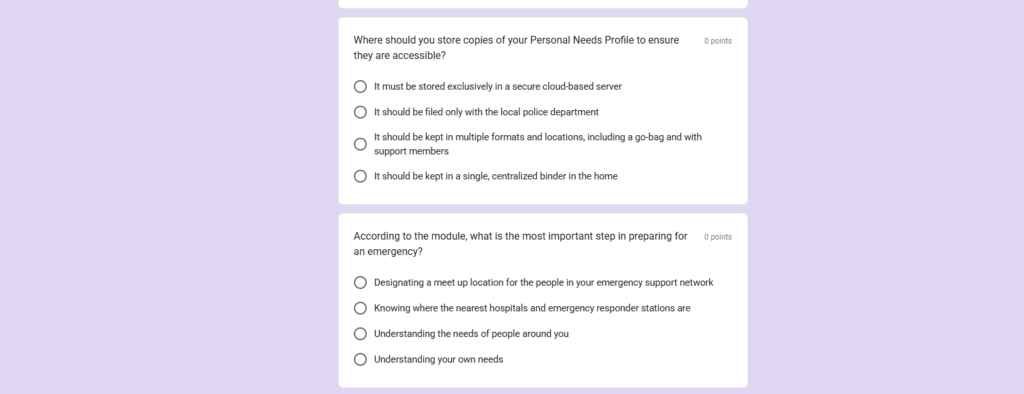
Test your understanding of this module with an eight-question quiz.
Thank you to our funding partner